Purpose
The PLC Pro develops and proves the equipment-level operation of each controlled machine element in Manual Mode before incorporating that element into an automatic operation.
This work establishes how each equipment action is requested and performed, the outputs and supporting functions required to carry it out, the permissives, interlocks, and conflicts governing the action, and the Current-State feedback that establishes the resulting equipment condition. Limited equipment-level sequences may also be developed and verified as part of this work.
Auto Mode is then built on these proven equipment-level functions. Automatic logic determines when an action should be requested and uses the established equipment control and Current-State information rather than duplicating the underlying control logic for automatic operation.
Develop and Prove Equipment-Level Operation
Developing Manual Mode requires the PLC Pro to establish how each controlled machine element is operated before that equipment becomes part of an automatic operation. The available equipment actions are identified, their commands are developed, and the resulting machine response can be observed directly.
Exercising those commands in Manual Mode allows the PLC Pro to develop and verify the intended equipment response. Direction, speed, acceleration, deceleration, and other operating characteristics can be established as applicable, while the actual movement or process response and associated Current-State feedback are observed and adjusted as needed.
For example, while commissioning a conveyor in Manual Mode, the PLC Pro may establish its “FWD” and “REV” directions, select appropriate jog and run speeds, configure acceleration and deceleration, and verify that the resulting conveyor movement is suitable for the installation. The associated feedback is also verified so that the PLC Pro’s non-safety-related program (the control program) accurately represents the conveyor's resulting operating condition.
This work also exposes operating details that may not have been apparent from drawings, descriptions, or the intended sequence alone. Required supporting functions, unexpected interactions, timing considerations, and equipment behavior can be identified while the machine element is being operated independently of automatic sequencing.
For example, commissioning may show that an action has reached its expected Current-State, but the equipment or process requires additional time to settle before the next action should begin. A moved part may still be oscillating, material may still be shifting, or pressure may need time to stabilize. The PLC Pro can establish an appropriate settling delay so that subsequent operation begins only after the result of the preceding action has become sufficiently stable.
Any required correction can therefore be made and verified at the equipment level before an automatic operation depends on that function. The result is a known and proven equipment capability on which later sequencing can rely.
Establish the Equipment-Level Control Foundation
Developing equipment actions establishes more than the operator commands used to request them. The PLC Pro identifies the physical outputs and supporting functions required to perform those actions and develops the equipment-level control logic that operates them.
The operation of physical outputs may be conditioned by applicable permissives, interlocks, and conflicts. The PLC Pro evaluates all applicable conditions when determining whether and how the control program asserts these outputs.
Some governing conditions are inherent to an equipment action and apply regardless of whether the request originates in Manual Mode or Auto Mode. Establishing these common conditions while developing Manual Mode functions allows the same permissives, interlocks, and conflicts to govern the equipment-level action in either mode without the need to duplicate them in the automatic sequence.
For example, a fixture clamp may be operated by either a Manual Mode clamp request or a clamp request generated when automatic sequence progression calls for the action. Those requests can be applied in parallel to common equipment-level output logic, where conditions such as available pressure and the absence of a conflicting unclamp request determine whether the physical clamp output may be asserted.
While commissioning Manual Mode functions, the PLC Pro also develops and verifies the Current-State information needed to establish the meaningful operating condition of each machine element.
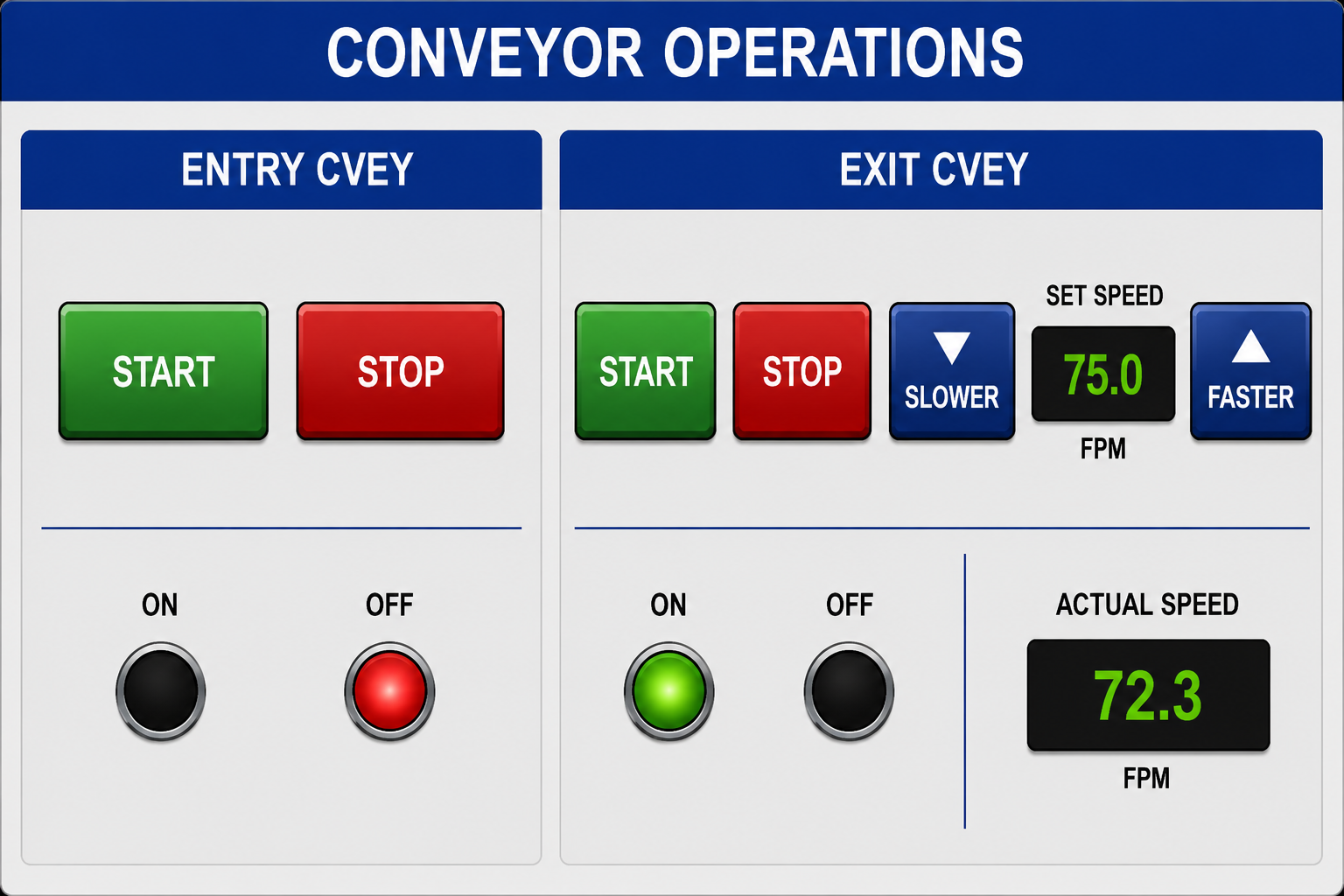
Commissioning also establishes which operating parameters should remain adjustable and which should become fixed characteristics of an equipment function. If testing establishes a suitable value that operators have no reason to change, the PLC Pro may fix that value in the control program and omit its adjustment from HMI. When an operating parameter is intended to be adjustable, HMI provides the appropriate controls and useful Current-State information associated with that adjustment.
The PLC Pro may also develop and verify limited equipment-level sequences as part of Manual Mode. This work includes the sequence's internal actions, supporting functions, governing conditions, and resulting Current-State.
For example, a “PICK” command for a vacuum pick head may lower the head to the pickup position, apply vacuum, wait for vacuum to be established, and then raise the head with the part. The PLC Pro can develop and verify this limited sequence while commissioning Manual Mode, establishing the internal actions, required conditions, timing, and Current-State that automatic operation can later use.
Together, the command logic, physical output control, supporting functions, permissives, interlocks, conflicts, limited sequences, and Current-State feedback form the equipment-level control foundation that automatic logic will later use.
Build Automatic Operations from Proven Functions
Once an equipment-level function has been developed and verified, automatic logic can request that same function when an automatic operation requires the corresponding equipment action. The source and timing of the request change, but the established equipment-level control does not need to be recreated for automatic operation.
The automatic sequence determines when an equipment action should be requested and what should occur after the required equipment condition is established. The equipment-level control determines how the requested action is carried out, operates the required outputs and supporting functions, and evaluates the permissives, interlocks, and conflicts associated with that action.
For example, a limited “PICK” function (see above) might be established and verified in Manual Mode. When automatic sequence progression calls for a part to be picked, the automatic sequence can request this previously established “PICK” function rather than reproducing those actions within the automatic sequence.
Current-State feedback developed and verified in Manual Mode provides equipment-condition information later used to establish sequence starting conditions, evaluate applicable conditions for continued operation, and confirm when sequence steps have completed.
Building automatic operations from these proven functions keeps the equipment-level behavior common to manual and automatic operation. A correction or improvement made to that common equipment control therefore does not have to be independently reproduced in each automatic sequence that uses the equipment.
PLC Pro Design Rules
- Fully develop and verify Manual Mode before beginning Auto Mode programming.
- Define the equipment-level commands, physical outputs, supporting functions, permissives, interlocks, and conflicts associated with each controlled action.
- Evaluate all applicable permissives, interlocks, and conflicts when determining whether and how physical outputs may operate.
- Use established equipment-level functions for automatic operation rather than duplicating their underlying control logic within automatic sequences.
- Equipment-level control determines how a requested equipment action is carried out.
- Use Current-State feedback to determine the equipment conditions on which automatic sequence progression depends.